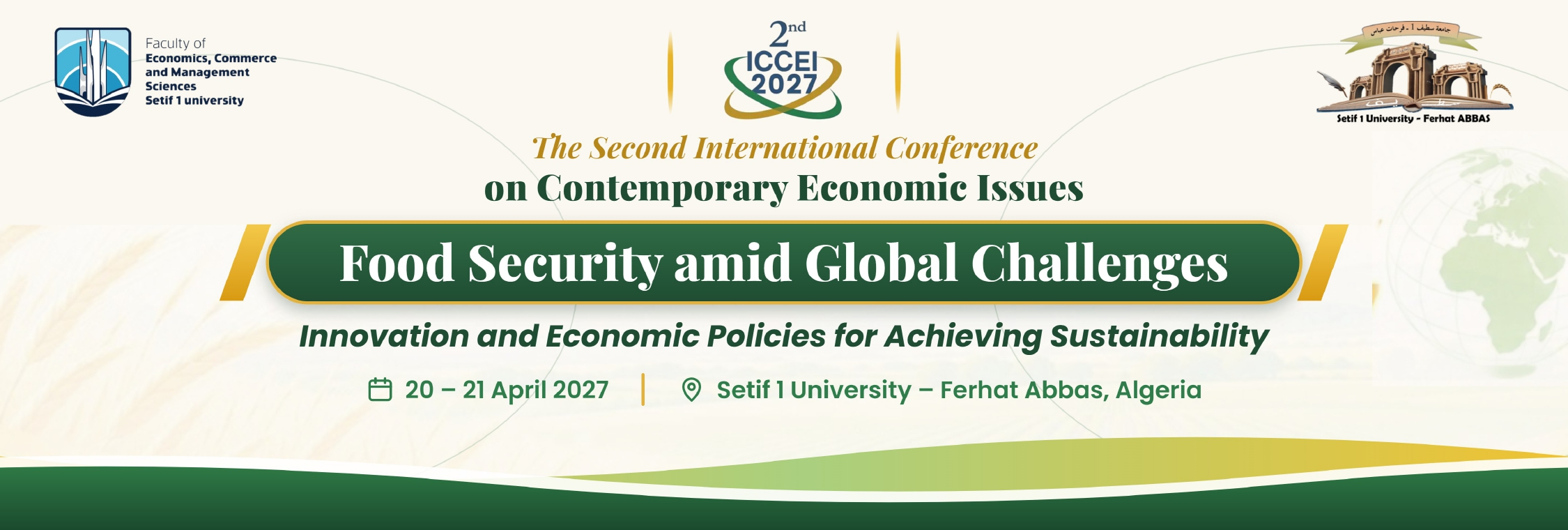
The conference addresses the issue of food security and sustainability through six interrelated themes covering its theoretical, policy, technological and environmental dimensions.
Theme 1: Economic Analysis Tools and International Measurement Indicators in Diagnosing Food Security
· The evolution of food security approaches in light of the 2030 Sustainable Development Goals.
· Analytical models and international measurement indicators of food security.
· The relationship between food security, economic security and social stability.
Theme 2: Global Shocks and Their Repercussions on Food Systems
· Geopolitical tensions and disruptions to supply chains and international trade.
· Climate change and natural disasters and their impact on the stability of agricultural production.
· Fluctuations in the prices of basic commodities and their impact on inflation and purchasing power.
· Assessing levels of structural vulnerability and import dependence in developing economies.
Theme 3: Economic and Financial Policies for Strengthening Food Autonomy
· Evaluating agricultural and trade policies between protectionism and liberalization, and their impact on domestic production.
· Reforming the food subsidy system so as to balance economic efficiency and social equity.
· Innovative and sustainable financing mechanisms for the agricultural sector, such as green finance, Islamic sukuk and venture capital.
· The role of public–private partnerships in modernizing agricultural infrastructure and logistics.
Theme 4: The Role of Innovation and Digital Transformation in the Sustainability of Food Value Chains
· Smart agriculture and applications of artificial intelligence and the Internet of Things in improving resource efficiency.
· Biotechnology and genetic improvement to cope with climate and water stress.
· The role of digitalization in supply chain traceability, storage management, and the reduction of food loss and waste.
· Entrepreneurship and start-ups in agricultural technology (AgriTech) and their role in developing innovation within processing industries.
Theme 5: Environmental Economics and Natural Resource Management
· The transition towards a green economy and a circular economy in agri-food systems.
· The economic governance of water resources, including smart irrigation, desalination and recycling.
· The economic assessment of the impacts of desertification and land degradation, and ways of mitigating them.
· Valorizing biodiversity and genetic resources as a tool for strengthening food resilience.
Theme 6: Institutional Governance and International Experiences
· Institutional frameworks and governance of the agri-food sector, and the complementarity of the roles of governments, the private sector and civil society.
· Regional economic integration and its role in enhancing food security, with reference to the African Continental Free Trade Area (AfCFTA) and the Arab region.
· A review of leading international experiences in achieving food sovereignty and building resilient and sustainable systems.
· The role of scientific research centers and international organizations in guiding public policy and technology transfer.
The Scientific Committee welcomes applied and econometric studies, as well as case studies, particularly those addressing the Algerian experience and the Arab and African contexts, alongside comparative studies of international experiences.