Food security constitutes a structural variable that determines economic and social stability, and a fundamental pillar of the sustainable development agenda. Recent international indicators confirm the widening of the food security gap worldwide: some 673 million people suffer from chronic undernourishment, while more than 2.3 billion people face food insecurity of varying severity, reflecting structural imbalances in the governance of food systems and in global supply and demand trajectories.
Food supply chains are subject to unprecedented pressures resulting from the interplay of geopolitical conflicts, extreme climate shocks, economic fluctuations and disruptions to international trade. These pressures are particularly acute in developing economies, especially in the African and Arab regions, where water scarcity, land degradation, demographic growth and dependence on food imports intersect, thereby increasing exposure to price shocks and supply constraints.
Addressing these imbalances requires moving beyond traditional approaches towards more sustainable economic models based on agricultural innovation, digital technologies, sustainable finance and the modernization of institutional governance. It also calls for the design of trade and investment policies capable of improving resource-use efficiency, strengthening storage and strategic capacities, and narrowing the food deficit gap at both the national and regional levels.
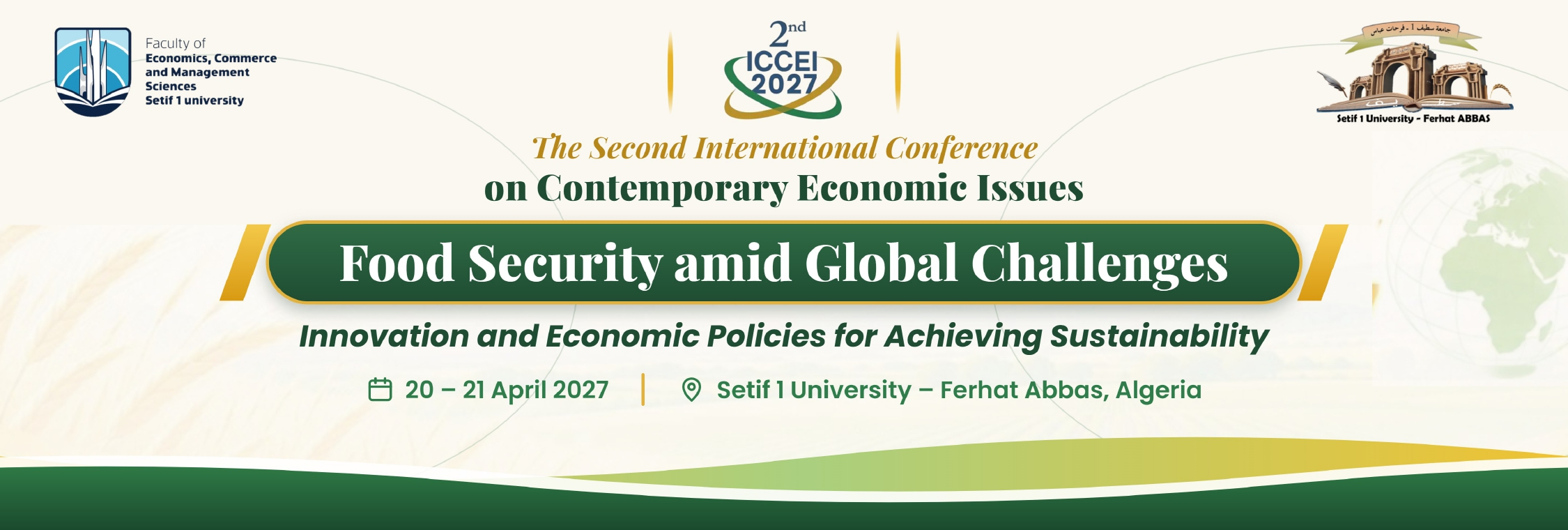
In this context, and in line with the 2030 Sustainable Development Goals and the orientations of global food systems, the Faculty of Economic, Commercial and Management Sciences at Ferhat Abbas Sétif 1 University is organizing the Second International Conference on Contemporary Economic Issues, with the aim of attracting rigorous and multidisciplinary scientific contributions, exchanging international expertise, and formulating practical recommendations that help policymakers and economic actors design more resilient, efficient and sustainable food systems.