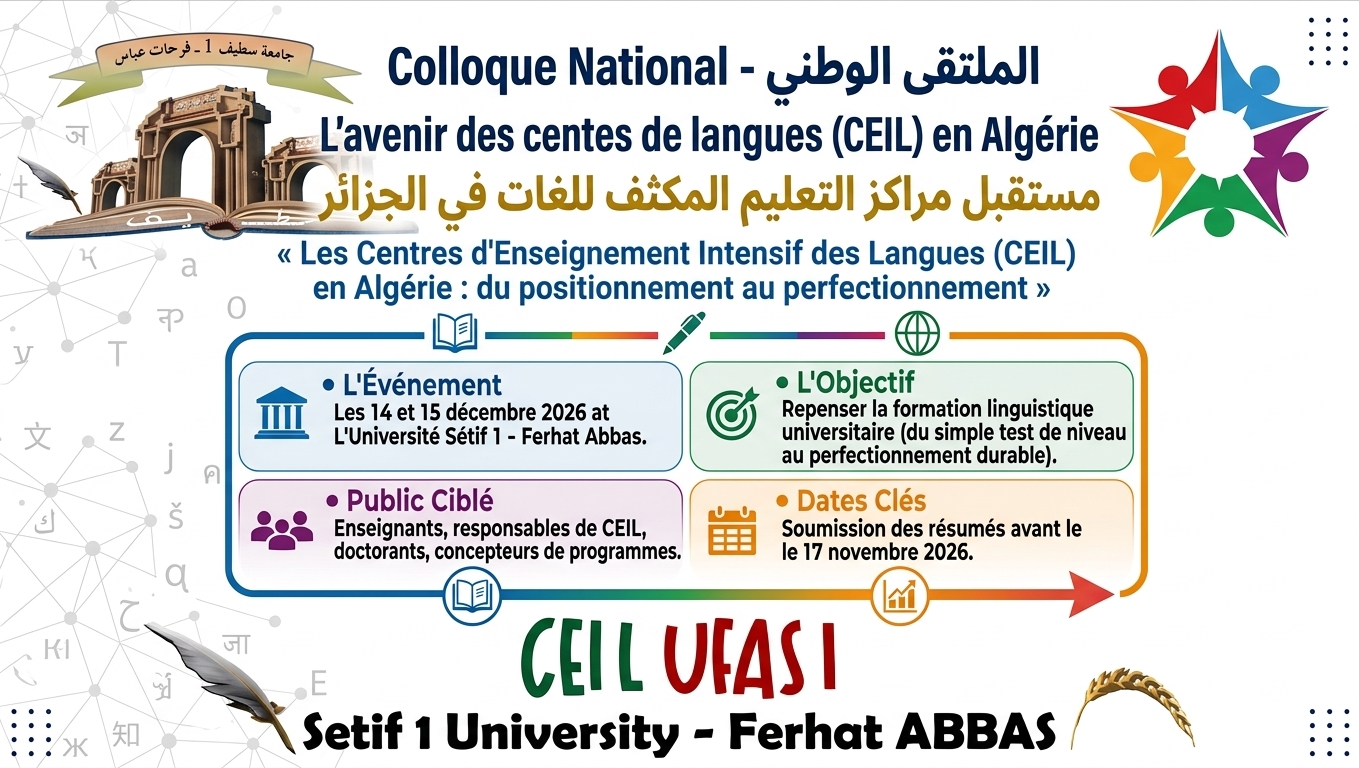
Changing learning contexts and increasingly diverse audiences call for a strategic, forward-looking and didactic examination of the training models adopted by university language centres.
This conference extends the study day held on 5 October 2026 by the LAILEMM laboratory at the University of Béjaïa, which addressed the design, contextualisation and harmonisation of placement tests in CEILs.
Since the 2022-2023 academic year, the Ministry of Higher Education and Scientific Research has implemented an English-language training programme for university teacher-researchers. Institutions with a CEIL are required to train their own teaching staff, with a distance-learning platform complementing the scheme.
By the end of 2023, some 64,000 teachers were reported to be in training, either face-to-face or online. The programme now extends to intensive language improvement placements in English-speaking countries, which became a priority under the mobility scheme adopted in March 2026. Within this framework, the CEIL of Ferhat Abbas University Sétif 1 administered an English placement test in April 2026 to teachers and staff enrolled in the international mobility programme.
This mission adds to the CEILs’ primary vocation: general or tailor-made courses open to all faculties and to external learners, in some ten languages depending on the centre (English, French, Spanish, German, Italian, Chinese, Turkish, Russian, Tamazight, and Arabic for international learners), including pathways in languages for academic or specific purposes. Yet the placement test is only the starting point of a learning pathway. What becomes of learners once they have been placed? How can they be supported, and how can their progress be measured and certified? On what materials should this progress be built? What remains of the learning gains a few months after the course, or after returning from abroad? And how can centres with different tools, platforms and audiences make their results comparable without standardising their practices?
The term “proficiency development” (perfectionnement) refers here to the learner’s progression beyond placement, towards target levels and towards academic and professional use of the language. It covers three settings: regular CEIL sessions, preparation for teaching in English, and intensive stays abroad framed by a pre-departure test.
Research Question:
To what extent can CEILs build, on the basis of the placement test, coherent training and assessment pathways that are tailored to their learners’ actual needs, supported by relevant materials, and whose outcomes are both durable and comparable across centres?